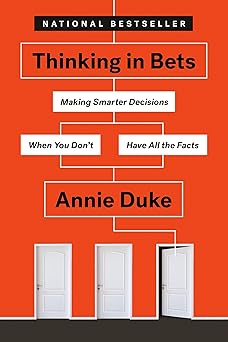
Thinking in Bets by Annie Duke Review: The Decision-Making Book Every Sports Bettor Needs
4.2 / 5
Overall Rating
Thinking in Bets by Annie Duke
Annie Duke won $4M playing poker and then became a decision-theory consultant. Her book is about a single distinction most bettors never learn to make.
Check PriceWe may earn a commission if you make a purchase through our links.
Thinking in Bets by Annie Duke — Review
Annie Duke was a top poker player — $4M in career earnings, WSOP bracelet, 10-year cash-game professional. After poker, she became a consultant on decision-making under uncertainty, working with companies, doctors, and sports organizations. Thinking in Bets is her distillation of what poker taught her about good decision-making versus good outcomes.
It's the single most important non-handicapping book sports bettors should read.
The Core Distinction
The book's central argument: a good bet and a winning bet are not the same thing. A good bet is one with +EV (positive expected value) at the time it's made. A winning bet is one where the outcome was favorable. Over large samples, good bets win more than they lose — but on any individual bet, a good bet can lose and a bad bet can win. This is obvious math but counter-intuitive in practice.
The cognitive error Duke labels "resulting" — judging a decision by its outcome — is the single largest failure mode in sports betting. Bettors retool their model after a loss on a bet that was +EV (because they can't separate quality from outcome). Bettors stick with bad strategies that happened to win recently (because outcome looked fine).
How This Applies To Betting
Post-bet review. Review bets by quality, not outcome. Did you have the right read on the market? Did your bankroll sizing match your edge? Was the line you bet into reasonable at the time? If yes, the bet was good even if you lost. Don't change a process that's EV-positive just because variance punished it last week.
Line moves vs outcomes. A line moving against you doesn't mean you were wrong. It means other bettors placed money. Their money can be wrong. Your original analysis might still be correct.
Avoiding tilt. Duke's chapter on tilt — the cognitive collapse after a losing bet leads to chasing or panicking — is worth the price of the book alone. Tilt is how most profitable strategies get thrown away by the bettor implementing them.
Updating correctly. When new information arrives, how much should your probability estimate change? Duke's treatment of small incremental updates vs large dramatic swings reinforces the Bayesian framework Tetlock documents in Superforecasting.
Where It's Thin
Sports-specific. The book uses poker examples primarily. Sports bettors have to translate the decision framework to their domain themselves. The translation is straightforward but not automatic.
Quantitative rigor. It's a practitioner book, not a statistics textbook. Pair with Tetlock's Superforecasting for the research-backed depth.
Who Should Read
Every sports bettor above the casual-fun tier. This is required reading if you're serious about long-term profitability.
Verdict
Short, clear, and genuinely changes how you think about your own betting over time. Read once, reread the tilt chapter after every losing streak.
Sports Betting Bankroll Calculator
Google Sheet template for tracking bets, calculating Kelly Criterion stake sizes, and monitoring your ROI across different sportsbooks.
Includes 12-month profit tracker
Instant download. No spam. Unsubscribe anytime.
Our Verdict
Affiliate Disclosure
Discussion
Sign in with GitHub to leave a comment. Your replies are stored on this site's public discussion board.